A stock rarely travels from entry to target in a straight line. It pauses. It pulls back. It tests levels. It may briefly move against you before continuing in the expected direction.
This creates one of the hardest problems in trading: deciding whether an unfavorable move is ordinary market noise or evidence that the trade idea is no longer valid.
Exit every time the price twitches against you, and you may repeatedly abandon good trades. Ignore every warning because you want to “give the trade room,” and a manageable loss can become a large one.
The answer isn’t simply to stay patient, but to define ahead of time what your “setup” is, and what would prove you wrong.
Before traders can learn not to react to noise, they need a practical way to recognize the difference between normal price movement and a genuine break in market structure.
First, what is a setup?#
A setup is a recognizable market situation that gives you a reason to believe one outcome is more likely than another.
It is not merely a chart shape or an indicator crossing a line. A complete setup includes several parts:
- The market conditions in which the idea makes sense
- The price behavior you want to see
- A trigger for entering
- A reasonable target, or multiple targets (also called “partials”)
- A specific event that would prove the idea wrong
For example, suppose a stock is trending upward and repeatedly forming higher highs and higher lows. It pulls back toward an area where buyers previously stepped in. Your setup might be to buy when the price holds that area and begins moving upward again.
Your reasoning is not simply, “This stock should go up.” It is:
Buyers have been controlling the trend. The pullback has not broken that trend. If buyers defend this area again, the upward move may continue.
The setup is invalidated if the behavior that justified the trade disappears—for example, if price decisively breaks the prior higher low and sellers remain in control.
Every setup is therefore a small hypothesis. You observe something, form an expectation and define what evidence would disprove it. If you cannot state what would disprove the idea, you do not yet have a complete setup.
Traders often specialize in one setup, or a small group of setups, and avoid candidates that do not meet their criteria. It might sound as though you are limiting your potential by not trading everything, but for a beginner, specialization is essential. It gives you the opportunity to understand one type of price behavior deeply instead of reacting superficially to every active stock.
I have personally chosen to focus on parabolic stocks. They can trade throughout the day, but I find them more manageable in the premarket.
What is market noise?#
Market noise is price movement that does not materially change the reason for your trade.
Markets move because buyers and sellers are continually negotiating price. Dr. Alexander Elder describes trends in terms of the changing strength of bulls and bears. In an uptrend, buyers (the “bulls”) repeatedly regain control after declines and push the market toward new highs. In a downtrend, sellers (the “bears”) repeatedly stop rallies and drive price toward new lows. When neither side can establish lasting control, the market trades in a range.
A single red candle does not automatically end an uptrend. One green candle does not necessarily reverse a downtrend. A brief move through a level may be a test, a liquidity sweep or simply the result of a wide spread in a thinly traded stock. Market control is revealed through a sequence of behavior, not the color of one candle.
Noise can include:
- An ordinary pullback within a trend
- A brief move through a level that is quickly reclaimed
- A temporary increase in volatility
- A single candle against the trade
- A small decline on light volume
- Price moving sideways while buyers and sellers reach a temporary balance, often called consolidation
- A test of the entry area that leaves the larger structure intact
Consolidation and distribution are not interchangeable terms. Consolidation simply describes price moving sideways. Distribution is a more specific interpretation: sellers may be unloading shares near the top of a move before price declines.
Whether a movement is noise depends on the setup and its timeframe. A ten-cent pullback could be meaningless in a volatile stock expected to move several dollars, yet it could invalidate a very tight scalp. A five-minute candle may look alarming to someone watching every tick but remain completely normal within a setup based on a 15-minute chart.
Noise is not defined by how uncomfortable the movement feels. It is defined by whether the evidence supporting the trade still exists.
What actually invalidates a setup?#
Invalidation occurs when the market does something that contradicts the central premise of the trade.
That is more specific than saying, “The price went against me.”
If you entered long because a stock was holding a series of higher lows, a decisive loss of the relevant higher low may invalidate the trade. If you shorted a failed breakout because buyers could not hold above resistance, a strong reclaim and acceptance above that level may prove you wrong.
Invalidation can take several forms.
1. Structural invalidation#
Structure is the visible framework created by swing highs, swing lows, support, resistance and ranges.
For a long trade, structural invalidation might be:
- A higher low fails
- Support breaks and cannot be reclaimed
- A breakout falls back into its former range and remains there
- Price begins forming lower highs and lower lows
For a short trade, it might be:
- A lower high is broken
- Resistance is reclaimed and holds
- A breakdown recovers back into the prior range
- Price begins forming higher highs and higher lows
The relevant structure must be chosen before entry. Otherwise, traders have a tendency to keep selecting a more distant level each time the nearer one fails.
2. Behavioral invalidation#
Sometimes a level technically holds, but the behavior around it changes.
Imagine buying a pullback in a strong uptrend. Previous pullbacks were shallow, brief and followed by decisive buying. This time, the stock repeatedly struggles to bounce, buying volume weakens and every small rally is immediately sold.
The original support level may not have broken yet, but the expected response from buyers is missing. That does not always demand an immediate exit, but it is meaningful information. A setup based on strong buyer response is weakened when that response never appears.
The same principle applies to a short. If sellers should take control below a failed breakout, but the stock remains firm and absorbs repeated selling, the expected behavior is absent.
3. Time invalidation#
Some setups should work relatively quickly.
A momentum breakout that cannot expand after several attempts may no longer offer the same opportunity. An opening-range trade that remains stalled long after the opening volatility has faded may have lost its reason for being. A stock expected to reject a level immediately may instead spend 20 minutes building acceptance above it.
Price is not the only information produced by a market. Time spent at a price matters too.
A trade does not necessarily have to move in your favor immediately, but you should know whether your setup allows ten seconds, three candles or half the morning to begin working.
4. Context invalidation#
A setup can also lose validity because the conditions surrounding it change.
Perhaps the broad market reverses sharply. A sector begins moving against the trade. Volume disappears. A news release changes the character of the stock. A low-float stock begins halting repeatedly, creating risk that was not part of the original plan.
Context alone should not become an excuse to react to everything on the screen. The question remains: Does this change undermine the conditions required by my setup?
A level is not always a particular price#
Beginners often treat support and resistance as exact prices. In practice, they are frequently better understood as zones. The width of the zone depends partly on the stock’s volatility and how hotly that price is being contested. A level visible on a longer timeframe generally carries more weight than one visible only on a very short-term chart.
A setup may also use a dynamic reference, such as VWAP—the volume-weighted average price—which changes throughout the trading session.
Before entering, decide exactly what failure will mean. I will give you an example based on one of my setups: the VWAP reversal.
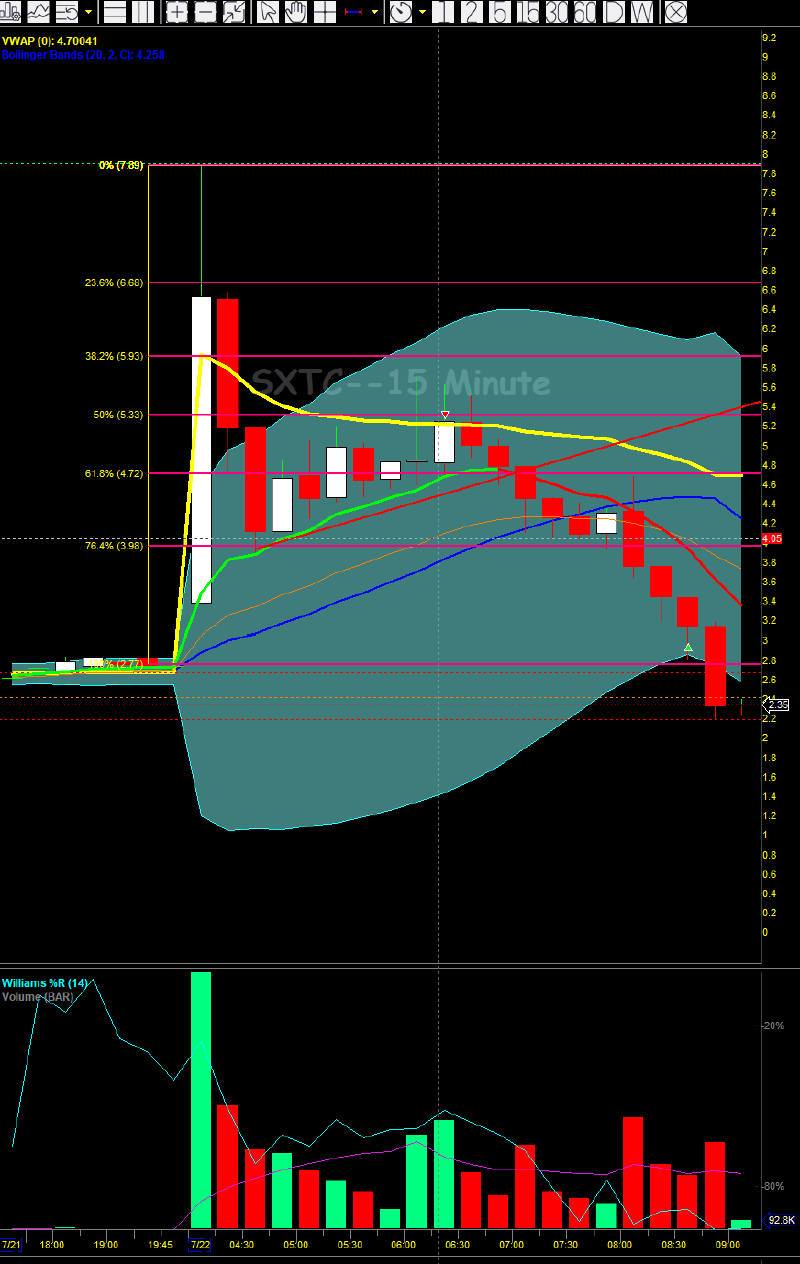
I entered short (marked at the red triangle), near VWAP—the yellow line on my chart. Immediately after I entered, price moved against me, but I considered that movement noise. My stop was not placed directly at my entry. I allowed some room for enthusiastic buyers to attempt a rally because, in the premarket, with VWAP sloping downward, my setup still favored a continuation lower.
However, if price had moved above the top of the prior candle’s wick, around $5.70, I would have considered exiting. Instead, the next candle’s upper wick topped out below the previous one. That lower high gave me additional confirmation that I was in the right setup.
Notice the Fibonacci overlay, which marks the range between the low near $2.80 and the high at $7.89. These levels help me identify reasonable targets and evaluate whether the trade is progressing in my favor.
There are also two moving averages on the chart. The blue line through the center of the teal Bollinger Bands is the 20-period simple moving average (20 SMA). The 9-period exponential moving average (9 EMA) is green when it slopes upward and red when it slopes downward. The relationship among price, the 9 EMA and the 20 SMA helps me judge whether the trend is up or down.
As a new trader, remember that “the trend is your friend.” As you gain experience, you will become better able to recognize when that trend is beginning to reverse.
As this trade progresses, I ask myself a series of questions:
- On the 15-minute chart, are the candles forming only wicks above VWAP rather than closing and holding above it?
- Did price fail to hold the 61.8% Fibonacci retracement?
- Did price move below the 9 EMA and the 20 SMA?
- Does the 9 EMA on the 15-minute chart continue to slope downward (red)?
- Is buyer volume weaker than seller volume? The volume bars are at the bottom of the chart.
- Are the 15-minute candles continuing to make lower highs and lower lows?
These questions will depend entirely on your setup. What matters is that you choose the evidence in advance. If you try to free-form your way through any active stock while paying attention only to price, your decisions will be influenced by fear, hope and your current profit or loss.
Your stop should express the invalidation#
A stop should not be placed where you would merely become annoyed or uncomfortable. It should normally sit where the trade premise is no longer valid, with a modest allowance for the ordinary movement of that particular stock.
This makes position sizing essential.
If the logical invalidation is 50 cents away and you are willing to risk $50, you cannot take 1,000 shares. In this example, your risk limit permits approximately 100 shares before accounting for slippage and fees:
\[ \$50 \div \$0.50 = 100\text{ shares} \]The solution is to reduce the position size—not to force the stop five cents from the entry simply because you want more shares. Another option is to wait for price to move into a range where the risk-to-reward ratio makes sense. If the invalidation point is too far away, do not force the trade.
A standard stop order becomes a market order when its stop price is reached, so it can execute at a worse price in a fast-moving or illiquid stock. A stop-limit order gives you more control over the execution price, but it may not fill at all if price moves beyond the limit. Investor.gov does a fantastic job of explaining the differences and risks of these order types.
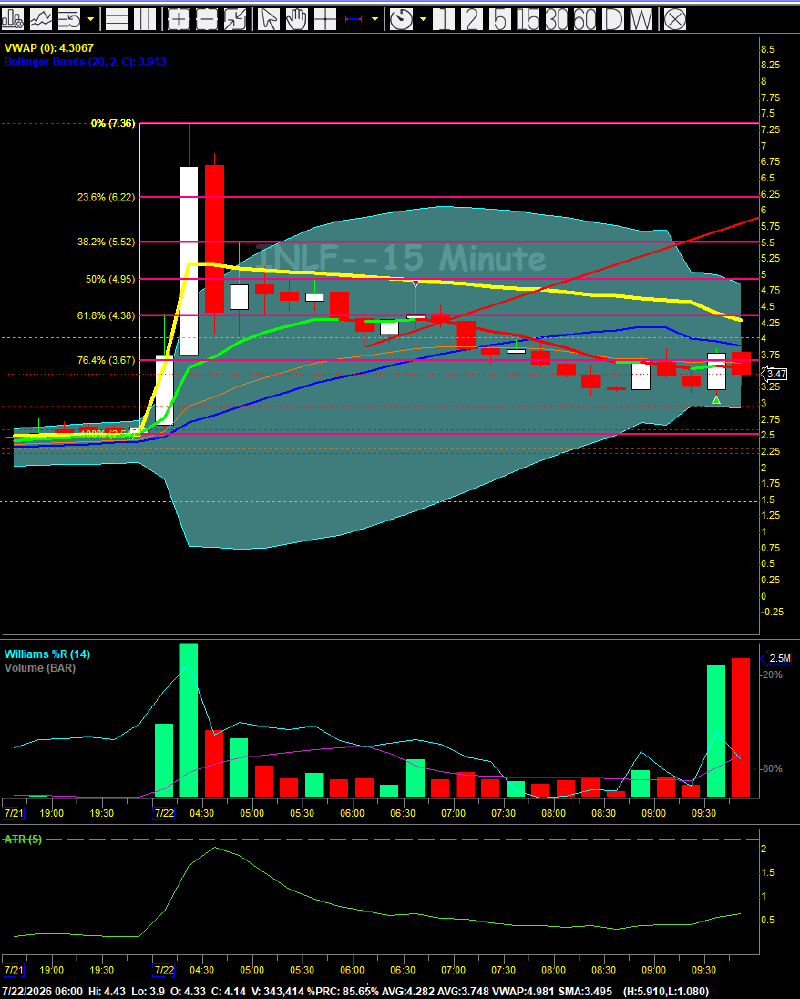
In this example, I waited until price reached VWAP and entered in the wick. I was short, and the red rectangle marks my entry. Price had been well below VWAP, and I believed it would continue lower, but I needed price to come to me to improve the risk-to-reward ratio. I placed my order on the chart at VWAP and waited.
Protecting your profit#
As a successful trade develops, the market may create new structure that allows you to move the stop and protect part of the gain. In my own trades, however, I am very careful not to do this prematurely.
These examples occurred in the premarket. Extended-hours order handling varies by broker. In my DAS and broker configuration, protective exit orders must be managed separately from the entry, and the orders eligible to execute in the premarket are limit orders. A limit order is not the same as a true stop: it may remain unfilled if price moves “through” your limit stop order (which can happen because the pre-market is typically more illiquid. This makes premarket trading more dangerous, but that deeper discussion belongs in another article. Investor.gov provides a useful overview of extended-hours risks and order restrictions.
During regular market hours, stops can often be better managed progressively with the trend of the trade. Suppose you are long and buy a pullback in an uptrend. The stock rallies, forms a new high and then establishes another higher low. Your original stop may have been below the earlier pullback. Once the new higher low is confirmed, that newer level may become the relevant invalidation point, allowing you to move the stop while still giving the trade room to continue.
In my INLF trade above, as price moved lower, I watched to see whether it could reclaim a Fibonacci level it had already failed. The 76.4% retracement had failed, so I anticipated that price could continue toward $2.55, that is, around the 0% retracement on the chart.
Buyers were more ambitious than I expected. If I had moved my stop to the 76.4% retracement, I could have been taken out while still preserving a portion of the profit. Instead, I believed the premarket sellers remained strong enough for me to wait for a retest of the earlier low, so I managed the position manually and closed around 9:30 a.m., when I believed the selling pressure might be exhausted.
That discretionary choice helped me maximize this particular trade, but it also carried more risk than a hard stop. It was not permission to abandon an invalidation point. If you manage a trade manually, the price or market behavior that will force your exit still needs to be decided in advance—and you must be able to act immediately when it appears. For a developing trader, a hard stop is usually the safer tool because it removes the opportunity to negotiate with yourself.
Useful principles are:
- Move the stop when the market gives you a new invalidation point—not merely when your profit becomes emotionally difficult to surrender.
- Recognize that price is often a tug-of-war. Pullbacks and retests are normal, but eventually every move loses momentum. Learning to recognize when the evidence has shifted—and when the best reasonable exit may already have appeared—comes with experience.
When you may not want to move the stop#
You may want to leave the original stop in place when:
- The stock has not yet created new, confirmed structure
- The setup normally retests the entry before expanding
- The proposed stop would sit inside normal volatility
- The spread is wide enough to trigger an overly tight stop
- You are reacting primarily to unrealized profit
- Your trading plan calls for managing the position only after a specific target or price event
This does not mean a stop should ever be widened merely to avoid taking a planned loss. Moving a stop farther away after entry changes the amount at risk and usually means you are refusing to accept the original invalidation (that more the more-rational-you-before-you-got-into-the-trade set with a level head).
A stop may remain where it is, or it may move in the direction that reduces risk when new structure justifies the change. It should not drift away from the market because you want more time to be right.
Four questions to ask before reacting#
When price moves against your position, ask:
What was the name of this setup and the premise of this trade?
State the reason in one sentence.What exact evidence did I define as invalidation?
Identify the level, behavior, structure or time condition.Has that event occurred, or am I responding to discomfort?
Separate chart information from emotion.Would I still enter this trade here if I had no current position?
If the honest answer is no, determine what has changed.
The fourth question is especially useful because an existing position creates attachment. We are so prone to defending our bad decisions rather than reading the market as it is. (It’s just human nature).
Discipline means responding to the plan#
“Hold your winners” and “cut your losses” are both incomplete instructions. A trader also needs to know what evidence separates a temporary pullback from a failed idea.
Real discipline is not stubbornness. It is not holding regardless of what the market does, and it is not exiting whenever fear appears.
Discipline means:
- Defining the setup before entering
- Identifying the expected market behavior
- Deciding what would invalidate the idea
- Sizing the trade so that the logical stop is affordable (some counsel no more than 2% of your capital)
- Allowing normal noise inside that boundary
- Exiting when invalidation actually occurs
- Moving the stop only when new structure justifies it
Dr. Elder’s broader approach to trading combines market analysis with risk management and self-management. That combination matters because reading the market correctly is not enough if fear causes you to exit every pullback—or hope causes you to ignore every structural failure. His updated book, The New Trading for a Living, emphasizes developing explicit trading plans and risk-control rules rather than making isolated decisions under pressure.
A good trader does not promise to stay in a trade. A good trader promises to stay faithful to the evidence.
Traders in training—me included—have made the mistake of remaining “faithful” to what we think is the plan (but it is only the fantasy) because we could swear the trade would eventually work out. Early but right can still blow up your account. That is dangerous behavior, and it is what stops are for.
This is where the line lies between staying with a trade that is working and disastrously sticking with one because you believe it should work. A stop ends the argument with the version of you who made the plan with a cool head before entering (or should have).
Before entering, decide what you need to see, what you are willing to tolerate and what would prove you wrong. Then ordinary movement can remain ordinary—and a real invalidation can receive the immediate respect it deserves.