Chapter 9: Deliberate Practice, Training Your Skills
Chapter 9: Deliberate Practice, Training Your Skills#
Practice and deliberate practice are not the same thing—especially in day trading.
Practice means repeatedly doing the activity. Deliberate practice means repeatedly training a specific skill, receiving objective feedback, and adjusting the next attempt based on what the evidence reveals.
A trader can practice for years without improving very much.
Ordinary trading practice#
Ordinary practice might look like this:
- Watching the market every morning
- Taking many trades
- Studying charts after the fact
- Watching educational videos
- Recording profits and losses
- Paper-trading familiar setups
- Thinking, “I’ll try to be more patient tomorrow”
This creates experience, but experience alone does not guarantee expertise. A trader may simply repeat the same errors until those errors become automatic.
Trading every day can even reinforce poor behavior:
- Entering because a stock is moving
- Taking profits prematurely
- Moving stops
- Adding to losing positions
- Inventing reasons for trades afterward
- Mistaking a profitable outcome for a good decision
Ten thousand trades do not necessarily create mastery. They may create one bad process repeated ten thousand times.
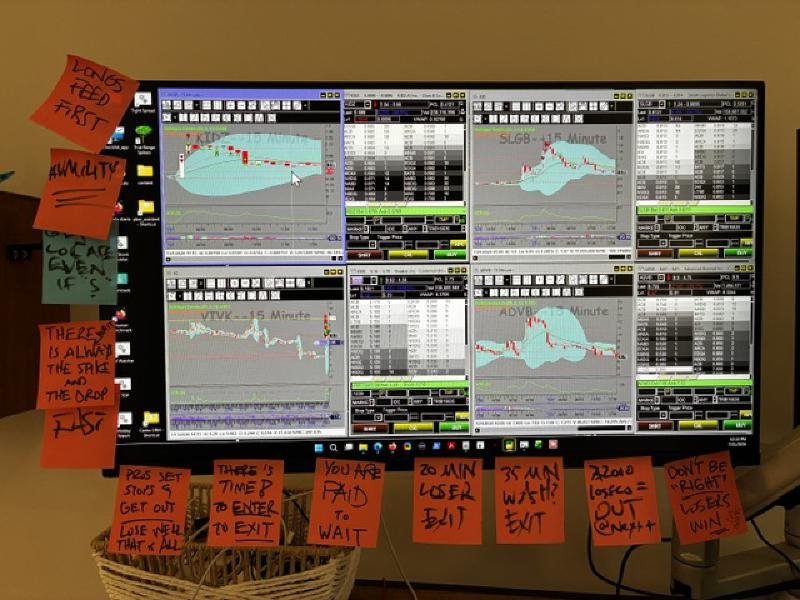
Deliberate practice#
Deliberate practice isolates one skill and gives the trader a way to measure whether that skill is improving.
It has several essential features:
A narrowly defined skill
Instead of “I am practicing trading,” the trader might practice:
- Recognizing a flattening 9 EMA at a parabolic peak
- Waiting for a second failed push before shorting
- Distinguishing absorption from temporary hesitation
- Holding a winning trade until a defined exit condition occurs
- Accepting the planned stop without interfering
- Passing on stocks that fail the premarket-volume requirements
A decision made before the outcome is known
This is crucial. Looking backward at a completed chart makes market behavior appear more obvious than it was.
Deliberate practice requires the trader to commit:
At this moment, with only this information available, I would enter, exit, hold, or pass.
When you replay trades — available as an add-on in DAS Trader Pro (access in File > Data Stream Mode) — ensure your future candles must remain hidden. Otherwise, the exercise tests hindsight rather than judgment.
Immediate, objective feedback
Learn what happened after each decision:
- How far did price move in the intended direction?
- How far did it move against your position?
- Was your stop appropriate?
- Were your targets realistic?
- Did you exit before the setup actually failed, or hold it against evidence (even if your stop was not touched)?
- Did you update your stop appropriately to reflect where progress in the move was invalidated?
- How much of the available move did the trader capture?
Collecting this amount of detail can seem too much work, or over obsession. But there are tools that can help you with the analysis, like journaling tools, (I use TraderSync), and the TapeVerdict tool.
Comparison with a defined standard
“It felt like a good trade" is not enough. “I made tons of money” is not enough, because if you made plenty in a poorly executed trade, poor execution will eventually come back and bite you.
The decision must be compared with written rules. For example:
- Did the stock meet the candidate criteria?
- Was the entry within five cents of the Fibonacci rung?
- Was price sufficiently below the 9 EMA / 20 EMA stack in an upward trend on my 15 minute chart?
- Was my planned R:R minimum 2:1?
- Was this the first qualified signal?
- Did the exit condition actually occur?
- Was the action permitted by the plan I created ahead of time?
These are not rules for one particular trade. They are meant to give you an idea of the types of questions a trades will ask herself.
A correction applied to the next attempt
The trader develops a precise adjustment:
When price reaches my target area but the exit conditions have not appeared, I will not cover merely because the unrealized profit feels valuable.
That correction is then tested repeatedly in similar situations.
A practical example#
Suppose your recurring problem is taking profits too early.
Ordinary practice would be taking more trades and trying to “be more patient.”
Deliberate practice could include:
- Reviewing 30 forward-only examples
- Entering and managing each one without seeing future candles
- Recording exactly why you covered
- Measuring maximum favorable excursion after the exit
- Comparing your exit with the planned EMA, Fibonacci, and volume conditions
- Identifying whether fear, a valid signal, or changing market information caused the exit
- Repeating the exercise with one explicit holding rule
You might discover that you are not generally “impatient.” Perhaps you specifically exit when unrealized profit first pulls back, even though none of your technical invalidation conditions has occurred.
That is a trainable diagnosis. “I need more discipline” is not.
Outcome versus decision quality#
One of the hardest lessons in trading is that a good decision can lose money and a bad decision can make money.
| Decision | Outcome | Proper evaluation |
|---|---|---|
| Followed the setup and stop | Loss | Good execution |
| Broke the rules | Profit | Bad execution |
| Passed because it was not “my setup | Stock later ran | Good restraint |
| Exited according to plan | More movement followed | Possibly still correct |
| Exited from fear before a signal | Profit protected | Process problem |
Ordinary practice tends to reward whatever made money. Deliberate practice rewards correct decisions under uncertainty.
Over a sufficiently large sample, you’ll be able to determine whether the rules themselves have an edge, and not just your luck.
There are no articles to list here yet.