How Some Traders Take Advantage of Wide Spreads for Profit#
Most new traders are taught to avoid stocks with wide spreads, often limiting themselves to names where the bid–ask difference is no more than a cent. But with this example, you’ll see that in the right conditions, a wide spread is not something to avoid—it is something to use.
In a low-float stock on its first day of trading, a wide spread signals thin liquidity and forced participation. Traders who need to act quickly have no choice but to cross it. If I am patient and use limit orders, I can position myself as the liquidity they depend on. If I am not, I become the one paying for their urgency.
Behavior of a First Day Stock#
This was Greenland Energy Company on its first day trading. There was no established range, no anchored VWAP that anyone trusted, and no prior support levels. Buyers had no reference for value. They were buying because price was going up.
That creates fragile positions.
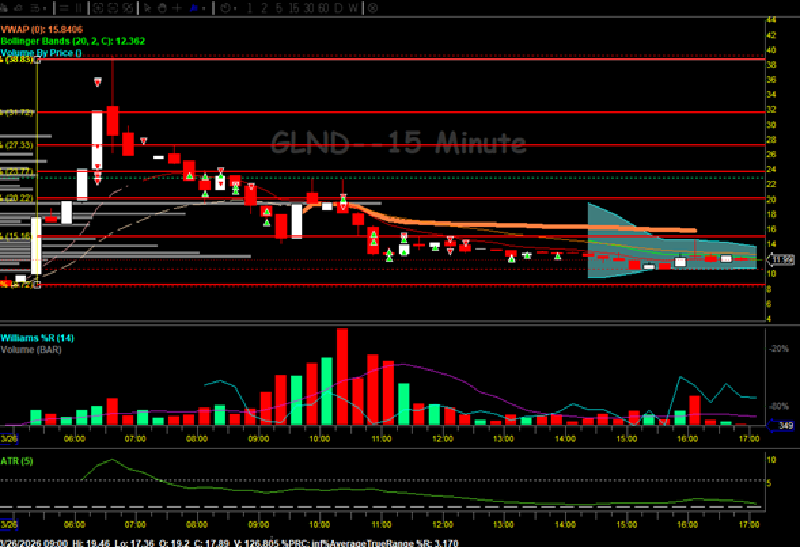
As price pushed higher, more traders chased, but they were not holding based on conviction. They were holding because of momentum. Once the stock stopped going up cleanly, those same traders had a problem. There was no liquidity to exit into.
The spread told the story. It was wide all day, sometimes as much as $0.50. That meant market makers were not stepping in to stabilize price. When traders wanted out, they could not ease out. They had to hit bids.
That is where the urgency came from.
I saw it directly on the tape. Bursts of prints hitting the bid. Not one trade, but sequences. Someone needed out immediately and was willing to accept whatever price was there.
That behavior is what created the opportunity.
Short Locates in a First Day HTB Stock#
Before I could even take the trade, I had to solve the locate problem. This was hard-to-borrow, and on a first day like this, availability is limited.
At first, I could only find a small number of locates. I bought 200 at $2.00 each. That alone was an $800 decision before even entering the trade. I have never paid that much, but the setup was strong enough that I accepted it.
Later in the day, I saw locates drop to around $1.00. That likely happened because more shares became available to borrow and because part of the move had already played out. Early in the day, there simply were not enough shares available.
This is important. With a broker like Cobra Trading, you pay for locates whether you win or lose. With IBKR, it is different, but in a stock like this, you often will not have access anyway. So this becomes part of the trade decision.
I was aware of the cost, but I still rushed the entry.
Entry Errors#
My first mistake came immediately after getting the locates.
Instead of waiting for confirmation, I shorted too early and swiped into the bid. In a stock with a wide spread like this, that is exactly what you should not do. I paid up to get in, and almost immediately price moved back through where I could have entered passively.
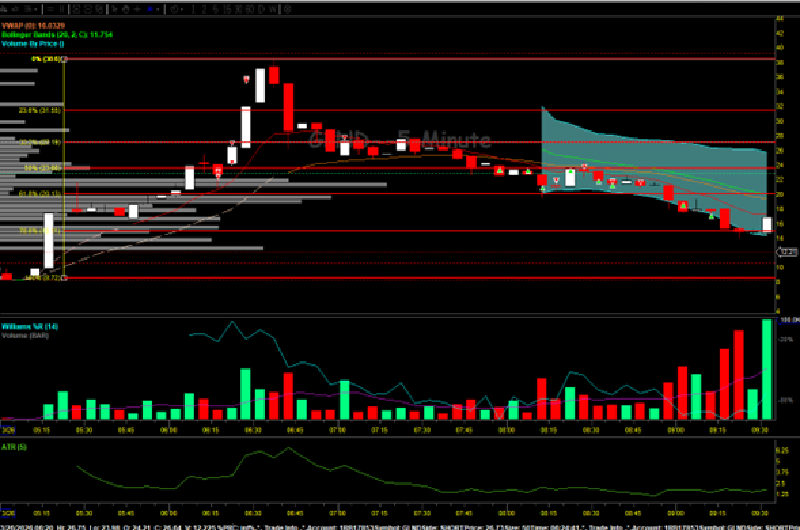
The bigger mistake was that I did not define my stop before entering. I know better than this. The first question should always be where the trade is invalidated. If I do not know that, I should not be in the trade.
But I let the excitement take over. (I am still new to trading as of this trade; learn from my mistakes!)
At that moment in the chart, there was still at least another 15 minutes of information needed to confirm that the stock would not push higher. If I had waited, it would have been clear that the stop belonged around $40.00.
Instead, I entered without that reference.
That decision cost me.
Between my early short and my later add, there was roughly a $5,000 swing against me. I watched my P&L go deeply negative before the trade worked. I added another 200 shares into that pressure, essentially averaging up on the wick, still without a clearly defined stop.
That is not good trading. That is stubbornness.
If I had stopped out at a controlled loss, even $1,000 or $2,000, and then re-entered at the correct level with a defined stop, the math would have been significantly better. Instead, I absorbed the full move against me.
I recovered because the structure ultimately played out, but that does not justify the entry.
Stop Caution in Fast Moving Markets#
This type of stock does not behave like a normal one.
Price does not move in clean increments. It can move several dollars at a time. If you are trading size, that translates into thousands of dollars very quickly.
If you were short 1,000 shares with an average around $29.00 and your stop was at $40.00, that is an $11 move. That is an $11,000 risk.
You cannot treat that casually.
In these environments, a traditional stop order is not always practical, especially pre-market where some hotkey-triggered stops may not function as expected. What matters more is having a clear invalidation level and the discipline to act when price approaches it.
You have to read the tape continuously. Who is in control? Are buyers still pushing? Is the move still expanding, or is it starting to stall?
If you cannot answer those questions in real time, this type of trading will be very difficult.
Using Limit Orders and Being the Liquidity#
Once I adjusted my execution, the trade improved immediately.
Instead of swiping, I began placing my orders and leaving them. This is where the wide spread becomes an advantage, but only if you let buyers and sellers come to you.
When I was short and saw large prints hitting the bid, I did not chase the exit. I placed my cover at that level and let sellers come to me. They needed to get out immediately. I did not because I knew that the trend was down.
Here for example, you see there is a bid for 12.51. If I was a little less than patient I would place my cover order at 12.51, but if I would just wait patiently, 12.51 is where that seller is confident the price is moving to, so I will wait with them.
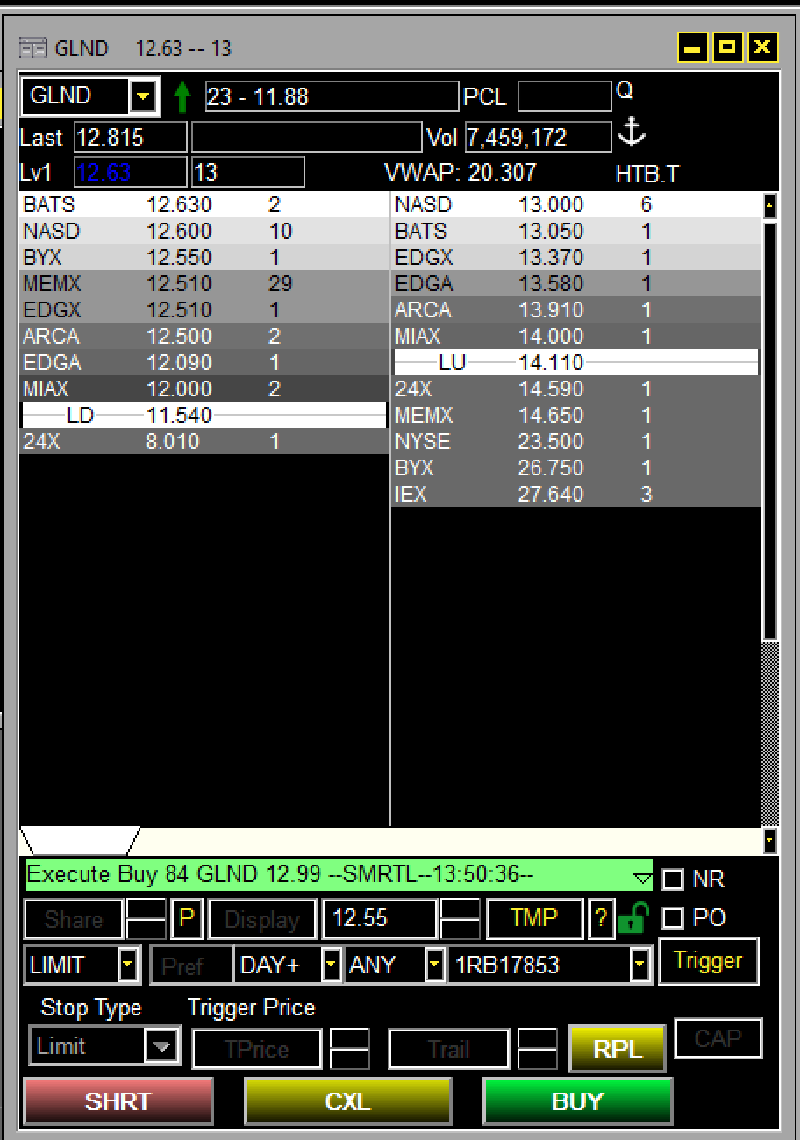
The result showed up in my ECN fees. On 2,386 shares, I paid around $5. If I had avoided swiping entirely, I likely would have been paid to trade. That is the difference between taking liquidity and providing it.
When I was patient, I covered at the exact moments where the move was most extended. When I was not, I paid for it.
Why Overextended Can Still Go Higher#
One of the reasons I traded this cautiously was a recent experience with another stock, UGRO. On March 23, I had shorted UGRO and made around $3,000. I covered near what turned out to be the low.
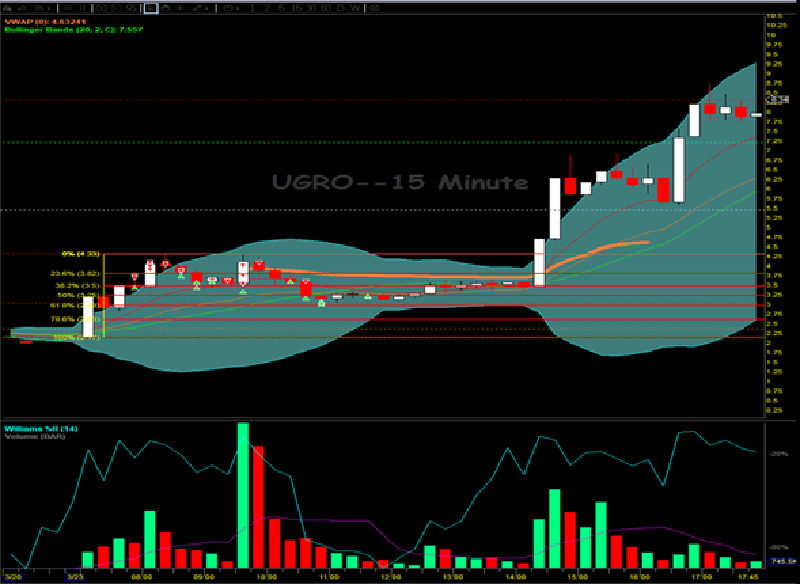
Over the next two days, the stock moved from around $13 to $55.
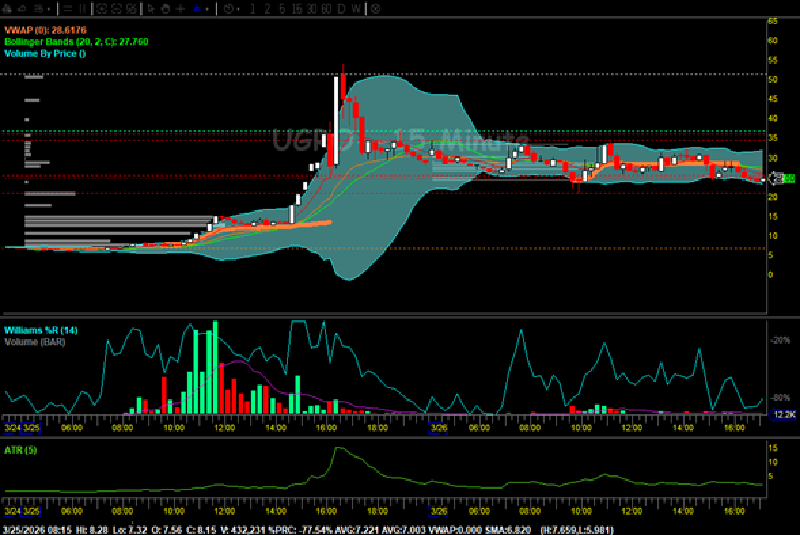
This goes to you you: Not everything that is overextended comes down. Sometimes it continues far beyond what seems reasonable. In UGRO, it barely retraced before continuing higher. It touched VWAP and then kept going, and going.
That experience stayed with me. No, it terrified me.
When I traded GLND, I was more cautious because I had just seen how wrong a short can go. That likely kept my size smaller than it could have been, but it also kept me from being reckless.
What Actually Happened#
By the end of the day, I made $1,335.
That reflects a mix of good reads and poor execution. My poor exits as well reflected the fear from what I knew could happen, though I have traded this setup hundreds of times, and it usually (usually, one bad time is enough for an attitude adjustment) works out the way I plan.
I identified the structure correctly. I recognized the behavior of a first-day stock. I saw the urgency on the tape and used it. Those times I was patient, and just let the buyers or sellers come to me, I was rewarded.
But left a lot of money on the table. This was a trade, that even with 400 shares could have made many thousands.
I entered too early. I swiped when I should have been patient. I traded too small relative to the opportunity. I covered too aggressively into some of the flushes instead of leaving a portion for continuation.
There was at least $5,000 lost on the entry alone from poor timing and lack of a defined stop. There was additional money left on the table on the exits.
Still, the most important part is clear.
The wide spread and lack of liquidity were not problems. They were the reason the trade worked. Traders were forced to act aggressively, and when I positioned correctly, I was able to use that behavior to my advantage.
Practice Makes Perfect, Somewhat#
This is one I will practice. In DAS Trader Pro you can get the option of Replay mode and download any of the stocks for the dates you see here and practice.
Practice makes perfect, somewhat, I say because I know the rules and still let my emotions get the best of me. I am a new trader in developments.
Good luck on your trading adventures.