Pre-Market Trading for Advanced Traders: Structure, Liquidity, and Opportunity#
Pre-market trading is neither inherently good nor bad—but it is very different.
For beginners, it often introduces unnecessary complexity. For experienced traders who understand liquidity, execution challenges, and catalyst-driven momentum, the pre-market session can be one of the most profitable windows of the trading day.
The rules of liquidity, volatility, and execution are simply different.
While many traders use this time primarily for preparation, others specialize in capturing the earliest phase of momentum. In some cases, the entire move in a stock unfolds before the opening bell.
When the Entire Move Happens Before the Open#
Catalyst-driven stocks can move dramatically before 9:30 a.m.
A typical sequence may look like this:
- News catalyst appears at 7:00 a.m.
- Volume surges between 7:30 and 9:00.
- Price climbs rapidly into the open.
- The regular session begins and momentum fades.
By the time most traders begin looking for opportunities, the move may already be over.
For momentum specialists, this early window can offer the highest probability opportunities of the day.
Participants in the Pre-Market#
The trading population during this session differs from regular hours.
Participants include:
- Professional momentum traders
- Proprietary trading firms
- International traders operating during their daytime hours
- Retail traders before their workday begins
This mixture produces a market environment with distinctive behavior and liquidity patterns. Liquidity often increases after about 7:00 a.m. Eastern Time as U.S. traders begin joining the market and European institutions—already active during their trading day—monitor U.S. equities more closely.
Liquidity Bursts#
Sudden bursts of volume—often associated with Intermarket Sweep Orders (ISOs)—are easy to spot in the pre-market and can be unsettling if you’ve never seen them before. An ISO is an aggressive order used by institutions or trading firms to rapidly execute large trades by sweeping liquidity across multiple exchanges at once.
On the chart this often appears as a sudden vertical move or a candle with unusually long wicks, with prints flying across the tape (time and sales window) in rapid succession. However, similar spikes can also occur when clusters of stop orders are triggered, multiple algorithms react simultaneously, or large marketable orders hit the book one after another. Because liquidity is thin before the open, these aggressive orders can push price through several levels instantly. What looks dramatic in the pre-market might only move a stock a few cents during regular trading hours.
In the pre-market, you may notice these bursts of aggressive order flow often appear around the hour (4:00, 5:00, 6:00, 7:00, 8:00, 9:00). Sweeps are not necessarily scheduled events, but there are reasons you may see this pattern.
- First, many institutional trading systems operate on time-sliced execution schedules. Algorithms designed to distribute large trades through the day often evaluate or rebalance positions at regular intervals (for example every 30 or 60 minutes). When those systems decide to execute, they may use aggressive orders—including ISOs—to remove liquidity quickly.
- Second, certain scheduled information events occur at predictable times. For example, U.S. economic data often appears at 8:30 a.m. Eastern Time, which can trigger immediate reactions from macro traders and algorithms.
- Third, human behavior contributes to the pattern. Traders frequently reassess positions on round time intervals such as the top of the hour. That can lead to clusters of orders entering the market around the same time.
- Finally, in the pre-market specifically, liquidity is thin. When several orders arrive at once—whether from institutions, algorithms, or reacting traders—the effect is more dramatic.
Some traders place targets near likely liquidity zones before anticipated bursts of activity, allowing their orders to be filled during these surges.
Reasons to Trade in The Pre-market#
You’re shorting a falling stock. When you trade in the pre-market, you could choose an illiquid stock because you are patient on entries, and want to capture part of the spread. This often works better in shorting than in long positions. The lack of liquidity and a heavy number of sellers (either profit takers or those early on bad news) will cause the price to collapse.
You’re trading a highly volatile stock, and you want to avoid LULDs. LULDs apply only during regular market hours. When trading a very volatile stock intraday, you could be subject to standard volatility halts governed by Limit Up-Limit Down (LULD). That is, after a surprise volatility halt, you could get lucky and the price could drop dramatically hitting your target(s) in seconds. Or you could be very unlucky, and on the reopen your market stop could have been hit several dollars higher, or worse, you’re running several thousand dollars in unrealized loss with no end in sight on your short sell and having to market out. If you can manage the pre-market environment with patience and caution, the lack of LULDs is an advantage.
Know your short availability. If you plan to short pre-market movers, confirm whether shares are available to borrow. With Interactive Brokers, shortable shares may appear without a separate locate fee, while brokers like Cobra Trading often require paid locates for hard-to-borrow stocks. Availability and locate prices are usually better earlier in the morning. If shares cannot be borrowed, your broker may force a buy-in after the market opens if shared cannot be borrowed. Find more information on shorting stocks here.
You want to capture part of the spread. Wide spreads are one of the defining characteristics of pre-market trading. While they present risk, they can also provide opportunity. A trader willing to hold firm on limit orders may occasionally receive fills inside the spread and targets on the other side of it. Capturing part of the spread becomes an additional source of edge. But patience is key, and chasing the price is a bad habit intensified by pre-market trading.
You trade catalyst-driven stocks. Example, a stock is up 100%, on dubious news, and the company has 5 employees. You look and there are 5 million participants and the spread is actually tight. The key is that enthusiasm may not be finished yet in the pre-market, and it could continue into the pre-market open. But where there is excess volatility, there is excess profit potential if you play it right.
You use increased volatility and low liquidity to your advantage. When there is low liquidity and lots of enthusiasm, a stock can spike or drop very quickly. For someone strategic, this can represent huge profits very quickly.
Huge Risks to Watch Out For#
- Market orders and stop-market orders are restricted, traders must manage risk manually. In thin liquidity, price can jump past a limit order without filling it.
- Most brokers do not support triggered market stops outside RTH (applies to IBKR and Cobra). Decreased liquidity and increased volatility, again, can mean if you do have a limit stop, the price could jump past it.
- Sweeps and other burst of activity can have outsized power in the pre-market, and your limit stop—even several dollars away from your current entry—can be triggered in these bursts, and so … some traders avoid stops entirely. And manually managing your trade is dangerous, risky behavior (that only advanced traders who make big profits days as a general rule) would risk taking.
Successful Pre-Market Candidates#
Successful pre-market trades typically share three characteristics:
- A strong catalyst
- High relative volume*
- Meaningful pre-market volume (often several hundred thousand shares or more)
- Tight spreads relative to the price (unless you are patiently trading the spread)
A stock could have very high relative volume, but still not be enough.
Execution Discipline#
Advanced traders approach pre-market execution carefully. Key principles include:
- avoid chasing price
- use limit orders strategically
- focus on stocks with genuine volume
- exit into liquidity bursts when possible
- be prepared to act quickly as trigger stops do not work
Trading Across the Open#
Spreads collapse near the open. Many premarket traders exit around 9:28–9:29 because:
- spreads tighten
- liquidity spikes
- institutions prepare for open
Catalyst-driven stocks can often be traded across the open if you are careful. (It can backfire).
An Example Pre-market Trade#
Here’s an example pre-market trade. And as I have said before on this site, feel free to learn from my mistakes! In this trade, the entire move happened before the open. The stock pushed hard into the early pre-market and topped out around around 1.20 before starting to roll over.
Notice how you’d be able to get short at an even better price if you were watching it at 5:30 a.m. But I was not into my computer yet. Still at around 6:15, I knew there was time to to potential make money on the downward momentum.
So I located 20,000 shares, but my initial short sell of 825 shares was light at $1.07. I next added another 1,000, then 1,000, and 1,175 shares, building a position of 4,000 shares. The price slipped under the short-term moving averages. While support at the Fibonacci retracement at 38.2% was obviously broken around $1.06, I did not load up to the full capacity I had (I had short located 20,000 shares). A little bit of fear, as a new trader, is my consistent problem.
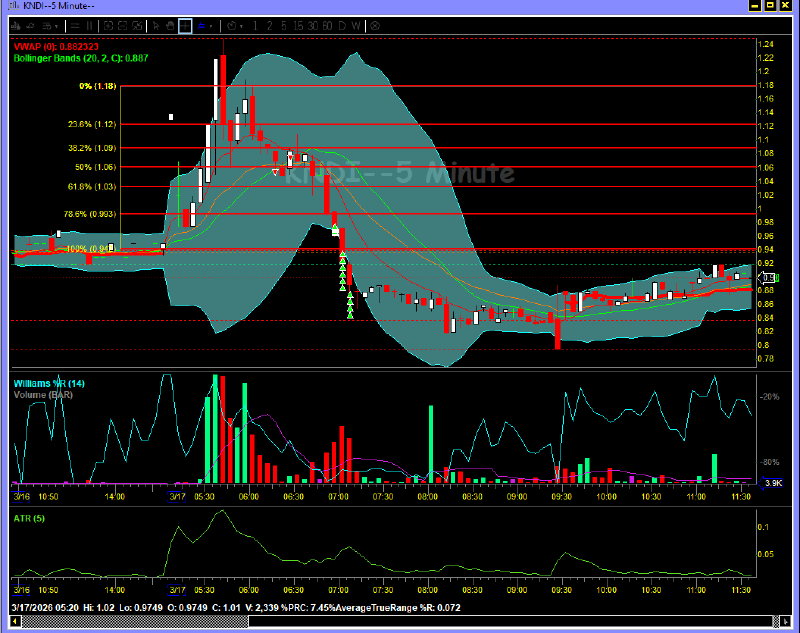
At $1.05 the price was trending cleanly lower under the moving averages, that was the moment to press. But I never increased size beyond the initial ~4,000 shares.
As the trade moved in my favor, I covered into the downside in pieces: 0.91, 0.90, 0.89, 0.88, and down to about 0.87. The execution on the way out was controlled and realistic for the pre-market. I was taking fills where liquidity existed instead of hoping for perfect exits. That part was good.
Looking back, this is a good example of being right but not maximizing the opportunity. I managed risk well and executed cleanly, but I treated a trending pre-market unwind like a series of small scalps. In conclusion two issues resulted in a lower profit:
- I did not load up as the breakdown confirmed.
- I could have placed my targets on the fibonnaci convergences, around $0.94 (100% retracement) and the horizontal line I did not draw, around $0.87 (the 127.2% retracement). Holding out for these targets, given the conditions are correct (sellers were overpowering buyers as the tape was confirming), would have been the best way to optimize my targets.
The greater lesson is that the edge in these moves is early. When downside momentum takes control in the pre-market, the most profitable part of the move often occurs before the open. By the time the regular session begins, much of the opportunity has already been realized.
While these moves can be highly profitable, they are not stable. In low-float stocks, a small number of aggressive buyers can shift price quickly in thin pre-market liquidity. Even clean blow-off setups can reverse if fresh demand steps in, especially as participation increases into the open. Limited borrow—such as only 20,000 shares available—can also create fuel for squeezes, because shorts are constrained while buyers are not.
Final Thoughts#
Pre-market trading is generally risky behavior only for the disciplined, patient and risk-tolerant trader. I do not recommend it for beginners; however, if you do want to give it a shot, always try it first in SIM.